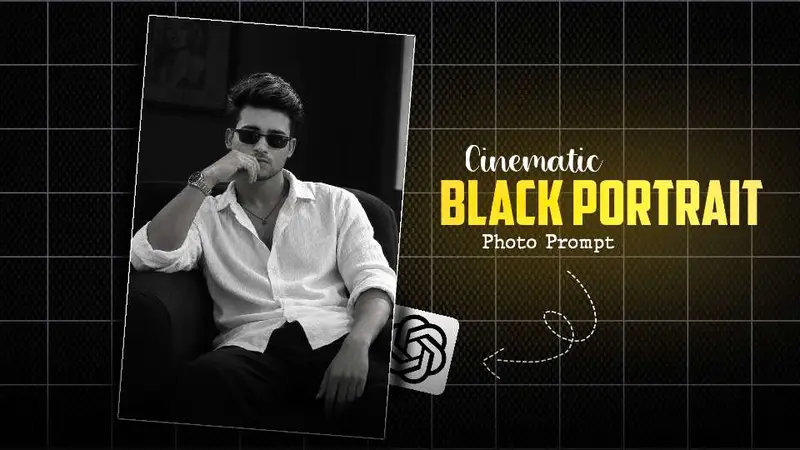
A cinematic black portrait prompt can turn an ordinary selfie into a dramatic, polished image with the mood of a fashion editorial or classic film still. This black-and-white AI photo trend is popular because it combines strong contrast, realistic detail, and a premium visual style without requiring advanced editing skills.
The best results do not come from applying grayscale alone. They depend on preserving the person’s identity, keeping the original pose believable, controlling the light, and giving the background enough depth to support the subject. With the right reference photo and a careful workflow, you can create an Instagram-ready portrait that still looks natural.
Cinematic Black Portrait Prompt Basics for Better Results
A successful AI portrait edit starts with a clear goal. Before opening an image tool, decide whether you want a profile picture, a Reel cover, a fashion-style post, or a moody personal portrait. Each use case may need a different crop, expression, and level of contrast.
The source image also matters. Choose a photo with visible facial features, even lighting, and enough space around the head and shoulders. A sharp image gives the editor more information to work with, while a heavily compressed or blurry selfie can produce strange details around the eyes, hands, hair, and clothing.
Use a well-focused portrait with a clear face.
Avoid strong beauty filters before editing.
Keep the face and hairstyle visible whenever possible.
Use a vertical image if the final result is for Stories or Reels.
Check that the reference photo shows the pose you want to preserve.
For general background on photographic composition and visual framing, the Wikipedia guide to portrait photography offers useful context. The same principles apply when an AI tool interprets a reference image.
How This AI Black and White Portrait Effect Works
AI editing tools interpret written instructions alongside a reference image. The text can describe camera perspective, lens appearance, lighting direction, clothing, background, facial identity, and the desired grayscale treatment. The reference supplies the visual foundation, while the instructions guide the transformation.
A strong cinematic black portrait prompt should be specific without creating contradictions. For example, asking for a low-key portrait, soft highlights, and deep shadows is consistent. Asking for both flat front lighting and intense side lighting creates confusion and may lead to an uneven result.
Identity preservation deserves special attention. Tell the tool to retain the subject’s face, natural proportions, skin texture, hairstyle, and recognizable features. Avoid instructions that ask for automatic beautification, face reshaping, or excessive smoothing. Those changes can make the final image look artificial and unlike the original person.
Element
Recommended direction
Why it matters
Camera view
Eye-level or gently compressed portrait perspective
Keeps facial proportions natural
Lighting
One directional source with controlled shadow
Creates a cinematic low-key mood
Color
Neutral monochrome with soft tonal transitions
Prevents harsh or muddy grayscale
Detail
Visible pores, hair strands, and fabric texture
Supports photographic realism
Background
Dark, simple, and slightly out of focus
Keeps attention on the subject
High-Contrast Editorial Portrait
Upload a clear reference image before using the block, and select an output ratio that matches your intended platform. If the first result feels too dark, make small adjustments rather than changing the whole direction at once.
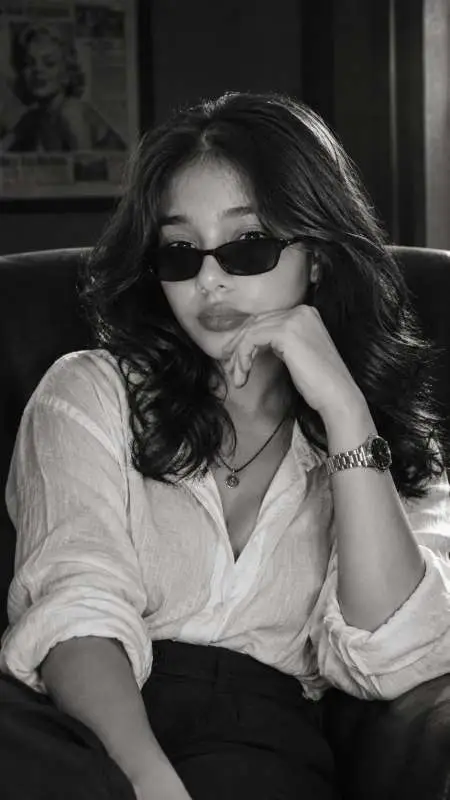
🚀 Create an ultra-realistic cinematic black-and-white portrait photograph using the reference image as the strict visual reference. CAMERA & ANGLE: Match the reference image’s exact camera angle, perspective, framing and composition. Vertical 9:16 portrait orientation. Camera positioned at approximately eye level, directly facing the subject with a subtle natural telephoto compression. Use an 85mm portrait-lens look, approximately f/1.8–f/2.2, with realistic depth of field. Do not use a wide-angle perspective. Keep the subject’s proportions natural, realistic and anatomically accurate. SUBJECT: A young adult woman sitting casually and confidently in a large dark armchair. Preserve the female subject’s natural appearance, proportions and authentic photographic presence. She should look like a real person photographed with a professional full-frame DSLR/mirrorless camera, not like a generated model or digital character. POSE & BODY POSITION: Young woman sitting casually and relaxed in the large dark armchair. Torso slightly angled while remaining generally toward the camera. Left arm rests naturally downward along the side/lap, with the hand relaxed. Right elbow is bent and raised, with the right hand naturally positioned in front of the mouth/lower face. Maintain the exact same relaxed posture, arm positions, shoulder position, head position, body orientation and overall pose as the reference image. Do not change the pose, body angle or composition. CLOTHING: Loose-fitting off-white/white lightweight textured button-up shirt with subtle vertical fabric texture. The shirt is slightly oversized, naturally wrinkled and partially unbuttoned around the upper chest. Long sleeves casually rolled up to around the forearms. Natural fabric folds, creases and realistic shadows. No graphic, logo or printed design underneath. Dark/black high-waisted trousers with a matte finish and natural fabric texture. Clothing should look elegant, minimal and realistic, with no exaggerated fashion styling. SUNGLASSES: Small-to-medium rectangular black sunglasses, dark tinted lenses and a slim dark frame. The sunglasses sit naturally on the bridge of the nose. Realistic subtle reflections on the lenses. Do not make the glasses oversized, futuristic or exaggerated. WATCH: On the raised wrist, a classic elegant silver/metal bracelet wristwatch with a dark round dial. Realistic metallic reflections, fine bracelet details and natural proportions. Keep the watch understated and sophisticated. NECKLACE: A simple thin dark/black cord necklace with a small round pendant, naturally resting around the upper chest. Minimal and elegant. HAIR: Keep the subject’s original hairstyle EXACTLY the same as in the provided reference image. Preserve the exact hairline, haircut, length, volume, direction, texture, parting, shape and individual styling details. Do NOT change, redesign, lengthen, shorten, straighten, curl, volumize or restyle the hair. FACIAL IDENTITY — EXTREMELY IMPORTANT: Keep the girl’s face 100% identical to the provided reference image. Do NOT create, add, invent, modify, reconstruct, beautify or enhance any facial features. Preserve exactly: facial structure face shape eyes eyebrows nose lips ears jawline cheekbones forehead chin natural skin texture facial proportions natural asymmetry exact likeness and identity The face must remain completely unchanged and recognizable as the exact same person from the reference image. Do NOT make the face more beautiful, slimmer, smoother, younger, older or more symmetrical. Do NOT apply beauty filters, skin smoothing, face reshaping or artificial facial enhancement. The sunglasses and hand may partially cover the face exactly as required by the pose, but do not invent or alter any hidden facial features. LIGHTING: Reproduce the reference lighting exactly: strong directional light coming from the upper-right/front-right side of the frame. The light softly illuminates the hair, forehead, sunglasses, shirt and raised arm, while the opposite side of the face and body gradually falls into deep shadow. Very low ambient fill. Dark, dramatic low-key lighting with natural shadow transitions. No front flash. No studio beauty lighting. No colored lights. No artificial rim light. No additional light sources. Maintain realistic light falloff across the face, clothing and arm. BACKGROUND: Keep the same dark sophisticated interior. Almost-black/dark charcoal wall behind the subject. In the upper-left background, include a framed vintage newspaper/poster featuring a classic female Hollywood portrait, kept dim and slightly out of focus. On the right side, retain a dark vertical architectural/curtain-like element with a narrow brighter vertical area. Background must remain subtle, dark and secondary to the subject. Maintain realistic depth separation between subject and background. BLACK & WHITE: Pure cinematic monochrome photography. Deep blacks, soft midtones, controlled bright whites, strong tonal separation and realistic grayscale skin tones. Natural skin should retain visible pores and authentic texture. Subtle authentic analog film grain, not excessive. High contrast but preserve realistic facial, skin, hair and fabric detail. REALISM: Ultra-realistic professional DSLR/mirrorless photography. Full-frame camera look. 85mm portrait lens. Approximately f/1.8–f/2.2. Natural optical depth of field. Realistic skin pores. Individual realistic hair strands. Authentic fabric texture. Physically accurate shadows. Natural anatomy. Subtle optical imperfections. Natural photographic sharpness. Realistic tonal roll-off. Cinematic editorial photography. High dynamic range without HDR artifacts. Ultra-detailed, 8K-quality photographic detail. IMPORTANT — NO AI LOOK: The final image must look like a genuine photograph taken by a professional photographer. No CGI. No 3D render. No digital painting. No illustration. No anime. No beauty-filter appearance. No plastic skin. No artificial facial symmetry. No exaggerated body proportions. No unrealistic anatomy. No excessive sharpening. No artificial HDR effect. STRICTLY PRESERVE: The girl’s exact face and identity, exact hairstyle, camera angle, perspective, framing, pose, body position, body proportions, head position, lighting direction, background arrangement, shirt style, sunglasses style, watch placement, necklace placement and monochrome cinematic aesthetic.
Inspect the eyes, fingers, sunglasses, and clothing edges after generation. These areas often reveal small inconsistencies, so a second pass with a short correction request can improve realism without changing the entire composition.
Realistic AI Portrait Prompt for Natural Identity
The second prompt block focuses on maintaining the original person while adding a polished cinematic treatment. It is useful when the subject’s recognizable appearance matters more than a heavily stylized transformation.
Natural Monochrome Character Portrait
For the most dependable result, use a front-facing or three-quarter reference with enough detail in the face and hair. Keep the source image free from stickers, strong color overlays, and extreme shadows that could hide important features.
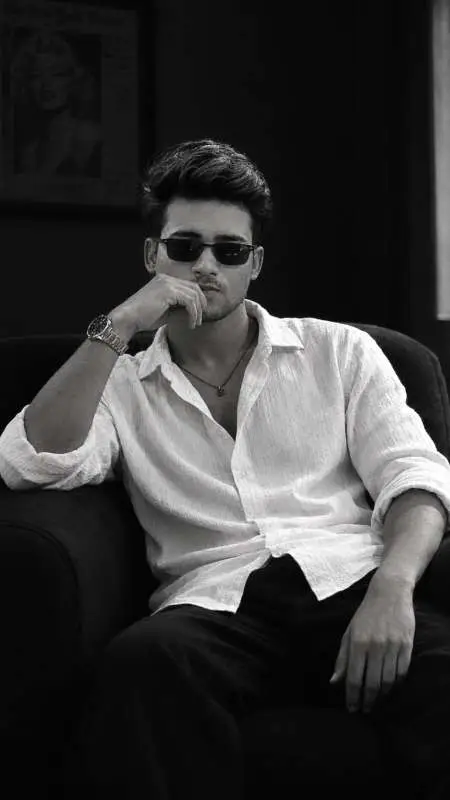
🚀 Create an ultra-realistic cinematic black-and-white portrait photograph using the reference image as the strict visual reference. CAMERA & ANGLE: Match the reference image’s exact camera angle, perspective, framing and composition. Vertical 9:16 portrait orientation. Camera positioned at approximately eye level, directly facing the subject with a subtle natural telephoto compression. Use an 85mm portrait-lens look, approximately f/1.8–f/2.2, with realistic depth of field. Do not use a wide-angle perspective. Keep the subject’s proportions natural and realistic. POSE & BODY POSITION: Young man sitting casually and relaxed in a large dark armchair. Torso slightly angled while remaining generally toward the camera. Left arm rests naturally downward along the side/lap, with the hand relaxed. Right elbow is bent and raised, with the right hand naturally positioned in front of the mouth/lower face. Maintain the same relaxed posture, arm positions, shoulder position, head position and body orientation as the reference. CLOTHING: Loose-fitting off-white/white lightweight textured button-up shirt, slightly wrinkled with visible vertical fabric texture. Shirt is partially unbuttoned around the upper chest. Long sleeves casually rolled up to around the forearms. Natural folds and realistic fabric shadows. Underneath, no visible graphic or printed clothing. Dark/black trousers with a matte finish. SUNGLASSES: Same style as reference: small-to-medium rectangular black sunglasses, dark tinted lenses, slim dark frame, sitting naturally on the bridge of the nose. Realistic subtle reflections on the lenses. Do not make the glasses oversized or futuristic. WATCH: On the raised wrist, a classic silver/metal bracelet wristwatch with a dark round dial. Realistic metallic reflections and fine bracelet details. Keep the watch elegant and understated. NECKLACE: Simple thin dark/black cord necklace with a small round pendant, naturally resting around the upper chest. LIGHTING: Reproduce the reference lighting exactly: strong directional light coming from the upper-right/front-right side of the frame. The light softly illuminates the hair, forehead, sunglasses, shirt and raised arm while the opposite side of the face and body gradually falls into deep shadow. Very low ambient fill. Dark, dramatic low-key lighting with natural shadow transitions. No front flash, no studio beauty lighting, no colored lights, no rim light and no additional light sources. BACKGROUND: Keep the same dark sophisticated interior. Almost-black/dark charcoal wall behind the subject. In the upper-left background, include a framed vintage newspaper/poster featuring a classic female Hollywood portrait, kept dim and slightly out of focus. On the right side, retain a dark vertical architectural/curtain-like element with a narrow brighter vertical area. Background should remain subtle and secondary to the subject. BLACK & WHITE: Pure cinematic monochrome photography. Deep blacks, soft midtones, controlled bright whites, strong tonal separation and realistic grayscale skin tones. Subtle authentic analog film grain, not excessive. High contrast but preserve natural skin and fabric detail. FACIAL IDENTITY — EXTREMELY IMPORTANT: Do NOT create, add, invent, modify or enhance any facial features. Preserve the original person’s face exactly as provided. Keep the same facial structure, eyes, eyebrows, nose, lips, ears, jawline, cheekbones, forehead, skin texture, proportions and natural likeness. Do not beautify, reshape, reconstruct, smooth or stylize the face. The sunglasses and hand may partially cover the face exactly as in the reference, but do not invent any hidden facial features. REALISM: Photorealistic DSLR/Mirrorless photography, extremely natural skin texture, realistic hair strands, authentic fabric texture, physically accurate shadows, natural anatomy, subtle lens depth, cinematic editorial photography, high dynamic range without HDR artifacts, ultra-detailed, 8K-quality photographic detail. STRICTLY PRESERVE: camera angle, perspective, framing, pose, body proportions, lighting direction, background arrangement, shirt style, sunglasses style, watch placement and monochrome aesthetic. most important : keep my face and hairstyle 100% same
Afterward, compare the generated image with the original at a similar size. The expression, jawline, hairline, and body proportions should remain believable. If the edit looks overly smooth, request natural skin texture and reduced beauty processing in the next attempt.
Best Settings for an Instagram Cinematic Portrait
Social platforms compress images, so detail and framing should be planned before export. A vertical 9:16 composition works well for Stories and Reels, while a square crop is often more practical for profile images. Leave enough breathing room around the head so the platform interface does not cover important facial details.
Use a moderate level of sharpening. Too much clarity can emphasize noise and make skin appear plastic. Similarly, a very deep black point may remove detail from hair, clothing, and the background. The goal is a rich grayscale range with visible information in both shadows and highlights.
Preview the image on a phone before posting.
Keep the face away from crop edges.
Check hands and accessories for unnatural shapes.
Use subtle grain instead of heavy noise.
Export a high-quality file before uploading.
Instagram’s official Reels information is helpful when planning vertical video covers and social content formats. Even when the final asset is a still image, platform-aware framing can make the post look more professional.
Common Problems With Cinematic Black Portrait Prompt Edits
Sometimes an AI editor changes the face too much. This usually happens when the reference is unclear, the instructions encourage beautification, or the prompt contains too many competing visual directions. Reiterate that the original identity and natural facial structure must remain unchanged.
Another common issue is flat lighting. A grayscale filter by itself does not create cinematic depth. Ask for a clear light direction, soft falloff, controlled highlights, and gradual shadows. If every part of the face is equally bright, the result may look like a basic black-and-white conversion rather than an editorial portrait.
Unnatural hands and accessories are also frequent problems. Review wristwatches, necklaces, glasses, fingers, and shirt buttons closely. If one detail is wrong, request a focused correction instead of regenerating the entire image with a completely different concept.
Problem
Likely cause
Practical fix
Face looks different
Weak reference or beauty instructions
Reinforce identity preservation
Image feels flat
No defined light direction
Add low-key directional lighting
Skin looks plastic
Over-smoothing or excessive detail
Request natural pores and restrained retouching
Background competes
Too much brightness or detail
Make the background darker and softer
Frequently Asked Questions About AI Black Portrait Editing
How do I use a cinematic black portrait prompt?
Start with a clear portrait reference and paste the selected prompt into an AI image editor that accepts image instructions. Review the first result carefully, then make targeted changes to lighting, framing, or identity preservation.
Can I use a cinematic black portrait prompt for Instagram?
Yes. This style works especially well for profile photos, Reel covers, Stories, and fashion posts. Choose a vertical crop for full-screen content and check the safe area so platform controls do not hide the subject.
Why does my AI portrait change the original face?
The tool may be interpreting the request as a character redesign rather than an edit. Use a sharper reference image, remove beauty-focused wording, and clearly request preservation of facial structure, hairstyle, expression, and natural asymmetry.
Conclusion: Build a Strong Cinematic Black Portrait Prompt
A compelling cinematic black portrait prompt combines a dependable reference image with clear instructions for identity, camera perspective, lighting, grayscale, and realism. The strongest edits are not necessarily the most dramatic; they are the ones that preserve the person while adding depth and visual polish.
Try one of the two prompt blocks with a well-lit portrait, then inspect the result carefully before sharing it. Adjust one element at a time, keep the composition simple, and create a cinematic profile image that feels both stylish and authentically yours.
Leave a Reply